Tuesday, 4 February 2014
John Virtue London Documentary
1. where is john virtue from and what type of art training did he do ?
john virtue is from the north east of lancashire in accrington.
He trained at the Slade School of Fine Art from 1965 to 1969.
2. what are the various subject matters of his work?
he did landscapes of where he lives and the places he visits.
3. how did his career as an artist develop?
in 1978/1980 he abandoned painting and developed with acid free board and moved onto pen and ink.
in 1980 he became a full time artist.
he then maintained a studio in exeter until he accepted an offer in the national art gallery in trafalgar square london.
4. what is the gallery that commissioned him to produce the art works?
the national art gallery in london commissioned him as Associate Artist at the National Gallery .The scheme engages contemporary artists to produce work that connects to the National Gallery Collection.
5. what type of work did he dicide to make for the gallery and in what way did the works of art relate to the exibition space he was making them for?
he decided to focus on the skyline of london.
marking out landmarks from the city like the gherkin,the natwest tower and st.pauls cathedral.
he did this in an effort to familiarise his audience with the hazy and smoggy drawings much like london.
6. what scale were his works of art and what are the materials and tools the he used to make them?
his canvases ranged from 3 by 4 inches to 12 by 9 feet
he used a number of materials such as :
shellac
black ink
white acrylic paint
earth
gouache
emulsion
and also tools like:
chinese brushes
kitchen utensils
pallet knifes
jade clothes
garden sprays
7.what processes and techniques does he use to make his work?
he uses ink in the garden sprays to create a smoggy effect to his painting and then adds an outline with the pallet knifes and jade cloths.
8. what style of work does he create?
he creates a contemporary style of work
9. how effective do you think the final outcome was?
i think the final outcome of his gallery was very effective because his canvases were and a very large scale
this allowed the audience to see the city how the artist sees it.
to go back from the paintings and see each one as a whole.
it allows his audience to see the murky smoggy perspective of the city .

Monday, 27 January 2014
townscape art history
liam spencer
- liam spencer was born in burnley in 1964.
-He studied fine art at manchester polythenic
-he lived and worked in manchester for many years.
seeing as how manchester is the second largest city in england and wales , i can understand why it would be his inspiration.
the bustling city around him might have been the reason he draws city life after living in more than one city in his life. by living in manchester for so many years , he is used to the surrounding city life.
in time the city would have become a part of who he is.
the main subject matter of liam spencers work is the city's night life .
manchester is based in the north west which is known for is gloomy weather.
like this painting which has rain , the rain reflects each light in the street and makes each wall and building glow.


- liam spencer was born in burnley in 1964.
-He studied fine art at manchester polythenic
-he lived and worked in manchester for many years.
the bustling city around him might have been the reason he draws city life after living in more than one city in his life. by living in manchester for so many years , he is used to the surrounding city life.
in time the city would have become a part of who he is.
the main subject matter of liam spencers work is the city's night life .
manchester is based in the north west which is known for is gloomy weather.
like this painting which has rain , the rain reflects each light in the street and makes each wall and building glow.
this oil painting is called the albert square twilight.
the painting is in a mixture of warm and cool colours.
the painting has a variety of shape but the artist doesnt paint everything neatly.
for example, the windows are very roughly painted in yet it still gives us the impression of a window being in that spot.
The street lights also work in an interesting way.
The lamps look as if they are just orbs of light that reflects the light off the walls of the buildings in a way that it normally wouldn't do.
the sky is also interesting.From the left a darker blue and to the right a lighter blue
the artist does this to give the impression of an ending sunset.
this oil painting was named deansgate twilight.
the painting has very warm colours but also cool colours for above the horizon.
the painting looks at if the artist did this piece very roughly but in essence the brush trokes give the impression of not only the movement of the cars but mainly the light.
this also revealse to the viewers of the painting of how the light gets spread around .
Liam spencer also makes use of cool dark colours above the horizon.
starting from the tops of the bridge to the end of the canvas .
just like in his other painting i chose to evaluate , he used a mix of dark and light blue for the sky to show the ending sunset in the distance.
i think that liam spencers work is semi abstract because his work isnt realistic but instead gives a different point of view of the city life
mainly of the light in the city that we take for granted.
stephen wiltshire
stephen wiltshire is a british architectural artist who has been diagnosed with autism.
he was born in london in 1974
he educated in the city and guilds of london art school. stephen became facinated in sketching landmark london buildings. after being shown a book of photos depicting the devastation wrought by earthquakes,he began to create detailed architectural drawings of imaginary cityscapes.
st pauls cathedral from london bridge
City of London skyscrapers of the future
both of these sketches were done in pencil but intentively for fine liner black pen
i really like stephen's work because he captures the moment and doesn't leave out any detail even buildings in the distance
what i also find interesting is how he lines out the horizon in both sketches.
even though close up each building has lines which are slightly rough, from a zoomed out point of view you start to realize that the artist made it that way so the viewers understand what he sees from his view.
i think that stephen wiltshires art is set in a realistic style
it is very detailed and his work is recognised easily from each and every landmark.
Tuesday, 7 January 2014
Cubism


Pablo Picasso


Jean Metzinger


that revolutionized European painting and sculpture, and inspired related movements architecture. Cubism has been considered the most influential art movement of the 20th century. The term is broadly used in association with a wide variety of art produced in Paris during the 1910s and extending through the 1920s. Variants such as Futurism and Constructivism developed in other countries.
The influence that led to Cubism was the representation of three-dimensional form
in the late works of Paul Cézanne, which were displayed in the 1907 Salon d'Automne. In Cubist artwork, objects are analyzed, broken up
and reassembled in an abstracted form—instead of choosing objects from one
viewpoint, the artist depicts the subject from a lot of viewpoints to
represent the subject in a greater context.
-i like this painting by braque because each section of the painting shows a significant amount of detail
- each cube and square has its own seperate section of light to mark out the woman.
-i like this painting by braque because each section of the painting shows a significant amount of detail
- each cube and square has its own seperate section of light to mark out the woman.

(girl with mandolin)
. Synthetic cubism was much more energetic, and often made use of collage including the use of several two-dimensional materials. This type of cubism was developed by Picasso. During the two artists' time of collaboration from 1907 and ending with the First World War,
PABLO PICASSO
Pablo Picasso
( 25 October 1881 – 8 April 1973) was a Spanish painter, sculptor, printmaker,
ceramicist, and stage designer who spent most of his adult life in France. As
one of the greatest and most influential artists of the 20th century, he is
known for co-founding the Cubist movement, the invention of constructed
sculpture,the co-invention of collage, and for the wide variety of styles that
he helped develop and explore.
Among his most famous works is the Les Demoiselles d'Avignon (1907)


Guernica
(1937)
a portrayal of the German bombing of Guernica
during the Spanish Civil War.
Picasso,
Henri Matisse and Marcel Duchamp are regarded as the three artists who most
defined the revolutionary developments in the plastic arts in the opening
decades of the 20th century, responsible for significant developments in
painting, sculpture, printmaking and ceramics.
Picasso
demonstrated extraordinary artistic talent in his early years, painting in a
realistic manner through his childhood and adolescence. During the first decade
of the 20th century, his style changed as he experimented with different
theories, techniques, and ideas. His revolutionary, artistic accomplishments
brought him universal renown and immense fortune, making him one of the
best-known figures in 20th-century art.
Tuesday, 17 December 2013
portrait artists
Vincent Willem van Gogh
30 March 1853 – 29 July 1890) was a post-Impressionist painter of Dutch origin whose work, notable for its rough beauty, emotional honesty and bold colour, had a far-reaching influence on 20th-century art. he suffered from years of painful anxiety and frequent bouts of mental illness,
He did not begin painting until his late twenties, completing many of his best-known works during the last two years of his life. In just over a decade, he produced more than 2,100 artworks, consisting of 860 oil paintings and more than 1,300 watercolors, drawings, sketches and prints.
His work included self portraits, landscapes, still lifes, portraits and paintings of cypresses, wheat fields and sunflowers.
In 1885, he painted his first major work ThePotatoEaters.
-this painting has a dark atmosphere
-each person in the painting has an almost shady figuration to them
- the room is being dimly lit up by the small gas light hung from the ceiling
the artist perfectly embeds the weak feeling of the light into the room
His pallet at the time consisted mainly of somber earth tones and showed no sign of the vivid colouration that distinguished his later work. In March 1886, he moved to Paris and discovered the french impressionists.
Later, he moved to the south of France and was influenced by the strong sunlight he found there. His work grew brighter in colour, and he developed the unique and highly recognisable style that became fully realised during his stay in Arles in 1888.
Famous pieces of work
Self portrait with straw hat -1887/1888
Starry night

i really like this painting because it shows no limitation to the light and shadows.
- the moon which over powers the stars.
- another great thing about this painting is how the starts and the moon blend in with the sky like each brush stroke marks the next
like they are all connected.
even the trees and the buildings reflect light .
Sunflowers

i like how in this painting each petal in different from the next yet they become combined into one singular flower.
the background is brighter than any of the flowers so it allows the flowers to have more influence in the whole painting.
Bedroom in arles
Portrait of dr.Gachet
Sorrow
Francis Bacon
(28 October 1909 – 28 April 1992) was an Irish-born British figurative painter known for his bold, graphic and emotionally raw imagery.
His painterly but abstracted figures typically appear isolated in glass or steel geometrical cages set against flat, nondescript backgrounds.
His breakthrough came with the 1944 triptych Three Studies for Figures at the Base of a Crucifixion which sealed his reputation as a uniquely bleak chronicler of the human condition.
this is a very freakishly looking painting
i really don't like the look of the mouths in the paintings because they look far from natural but give a realistic look.
the figures sand out more because of the orange background.
He often said in interviews that he saw images "in series", and his artistic output typically focused on a single subject or format for sustained periods.
His output can be crudely drawn as consisting of sequences or variations on a single motif; beginning with the 1940s male heads isolated in rooms, the early 1950s screaming popes, and mid to late 1950s animals and lone figures suspended in geometric structures.
These were followed by his early 1960s modern variations of the crucifixion in the triptych format. Following the 1971 suicide of his lover George Dyer, his art became more personal, inward looking and preoccupied with themes and motifs of death.The climax of thisperiod came with his 1982 "Study for Self-Portrait", and his late masterpiece Study for a Self Portrait -Triptych, 1985-86.
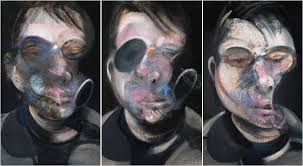
i find these painting very disturbing
i think because of the suicide of his lover he rampaged into a state where he became disfigured in this mind and used what he saw himself as into a distressed painting selection.
Famous pieces of work
Study for a Self Portrait -Triptych, 1985-86
triptych Three Studies for Figures at the Base of a Crucifixion 1944
Pablo Picasso
25 October 1881 – 8 April 1973) was a
Spanish painter
sculptor
printmaker
ceramicist
stage designer
As one of the greatest and most influential artists of the 20th century, he is known for co-founding the Cubist movement, the invention of constructed sculpture,the co-invention of collage, and for the wide variety of styles that he helped develop and explore. Among his most famous works are the proto-Cubist
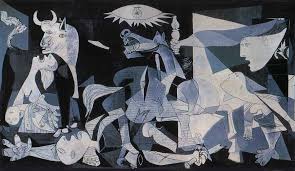
this painting is randomized into different (beings)
bulls and faces of people
the cold colors look like emotionless and unaccepted demons.
the painting looks like a cold definition of hell.
30 March 1853 – 29 July 1890) was a post-Impressionist painter of Dutch origin whose work, notable for its rough beauty, emotional honesty and bold colour, had a far-reaching influence on 20th-century art. he suffered from years of painful anxiety and frequent bouts of mental illness,
He did not begin painting until his late twenties, completing many of his best-known works during the last two years of his life. In just over a decade, he produced more than 2,100 artworks, consisting of 860 oil paintings and more than 1,300 watercolors, drawings, sketches and prints.
His work included self portraits, landscapes, still lifes, portraits and paintings of cypresses, wheat fields and sunflowers.
In 1885, he painted his first major work ThePotatoEaters.
-this painting has a dark atmosphere
-each person in the painting has an almost shady figuration to them
- the room is being dimly lit up by the small gas light hung from the ceiling
the artist perfectly embeds the weak feeling of the light into the room
His pallet at the time consisted mainly of somber earth tones and showed no sign of the vivid colouration that distinguished his later work. In March 1886, he moved to Paris and discovered the french impressionists.
Later, he moved to the south of France and was influenced by the strong sunlight he found there. His work grew brighter in colour, and he developed the unique and highly recognisable style that became fully realised during his stay in Arles in 1888.
Famous pieces of work
Self portrait with straw hat -1887/1888
Starry night
i really like this painting because it shows no limitation to the light and shadows.
- the moon which over powers the stars.
- another great thing about this painting is how the starts and the moon blend in with the sky like each brush stroke marks the next
like they are all connected.
even the trees and the buildings reflect light .
Sunflowers
i like how in this painting each petal in different from the next yet they become combined into one singular flower.
the background is brighter than any of the flowers so it allows the flowers to have more influence in the whole painting.
Bedroom in arles
Portrait of dr.Gachet
Sorrow
Francis Bacon
(28 October 1909 – 28 April 1992) was an Irish-born British figurative painter known for his bold, graphic and emotionally raw imagery.
His painterly but abstracted figures typically appear isolated in glass or steel geometrical cages set against flat, nondescript backgrounds.
His breakthrough came with the 1944 triptych Three Studies for Figures at the Base of a Crucifixion which sealed his reputation as a uniquely bleak chronicler of the human condition.
this is a very freakishly looking painting
i really don't like the look of the mouths in the paintings because they look far from natural but give a realistic look.
the figures sand out more because of the orange background.
He often said in interviews that he saw images "in series", and his artistic output typically focused on a single subject or format for sustained periods.
His output can be crudely drawn as consisting of sequences or variations on a single motif; beginning with the 1940s male heads isolated in rooms, the early 1950s screaming popes, and mid to late 1950s animals and lone figures suspended in geometric structures.
These were followed by his early 1960s modern variations of the crucifixion in the triptych format. Following the 1971 suicide of his lover George Dyer, his art became more personal, inward looking and preoccupied with themes and motifs of death.The climax of thisperiod came with his 1982 "Study for Self-Portrait", and his late masterpiece Study for a Self Portrait -Triptych, 1985-86.
i find these painting very disturbing
i think because of the suicide of his lover he rampaged into a state where he became disfigured in this mind and used what he saw himself as into a distressed painting selection.
Famous pieces of work
Study for a Self Portrait -Triptych, 1985-86
triptych Three Studies for Figures at the Base of a Crucifixion 1944
Pablo Picasso
25 October 1881 – 8 April 1973) was a
Spanish painter
sculptor
printmaker
ceramicist
stage designer
As one of the greatest and most influential artists of the 20th century, he is known for co-founding the Cubist movement, the invention of constructed sculpture,the co-invention of collage, and for the wide variety of styles that he helped develop and explore. Among his most famous works are the proto-Cubist
Picasso, Henri Matisse and Marcel Duchamp are regarded as the three artists who most defined the revolutionary developments in the plastic arts in the opening decades of the 20th century, responsible for significant developments in painting, sculpture, printmaking and ceramics.
Picasso demonstrated extraordinary artistic talent in his early years, painting in a realistic manner through his childhood and adolescence. During the first decade of the 20th century, his style changed as he experimented with different theories, techniques, and ideas. His revolutionary, artistic accomplishments brought him universal renown and immense fortune, making him one of the best-known figures in20th-century art.
Famous pieces of work
Les Demoiselles d'Avignon (1907)

i like the way the use of brown and tanned skin looking colour is used in this painting.
the way the different colour parts are turned into blocks like a certain part for each section of the body.
i find the disfigured heads disturbing especially the face with bulging eyes.
it looks like a monkey and a human head has been mixed together
Guernica (1937)
this painting is randomized into different (beings)
bulls and faces of people
the cold colors look like emotionless and unaccepted demons.
the painting looks like a cold definition of hell.
Subscribe to:
Posts (Atom)